BLDC Fan Motor vs AC Induction Motor: How to Choose for HVAC Equipment
BLDC and AC fan motors move air the same way but fail differently and cost differently. A decision-grade comparison for HVAC equipment designers, with a nine-row table and a selection checklist.
On this page
A BLDC fan motor and an AC induction fan motor move air through the same impeller. What differs is how the rotating field is produced, and how much airflow control the equipment designer keeps once the impeller is chosen. This comparison is written for HVAC designers committing a platform.
Where the two motors differ
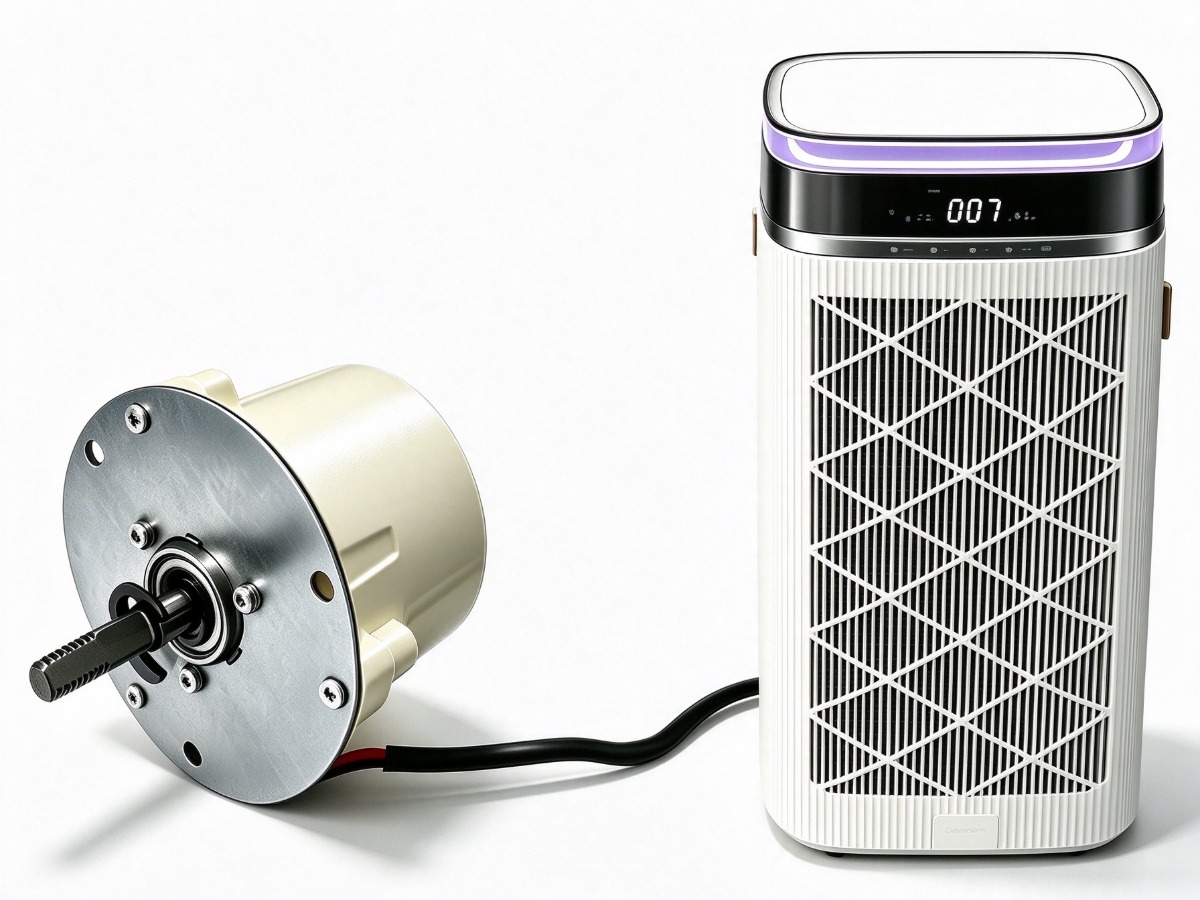
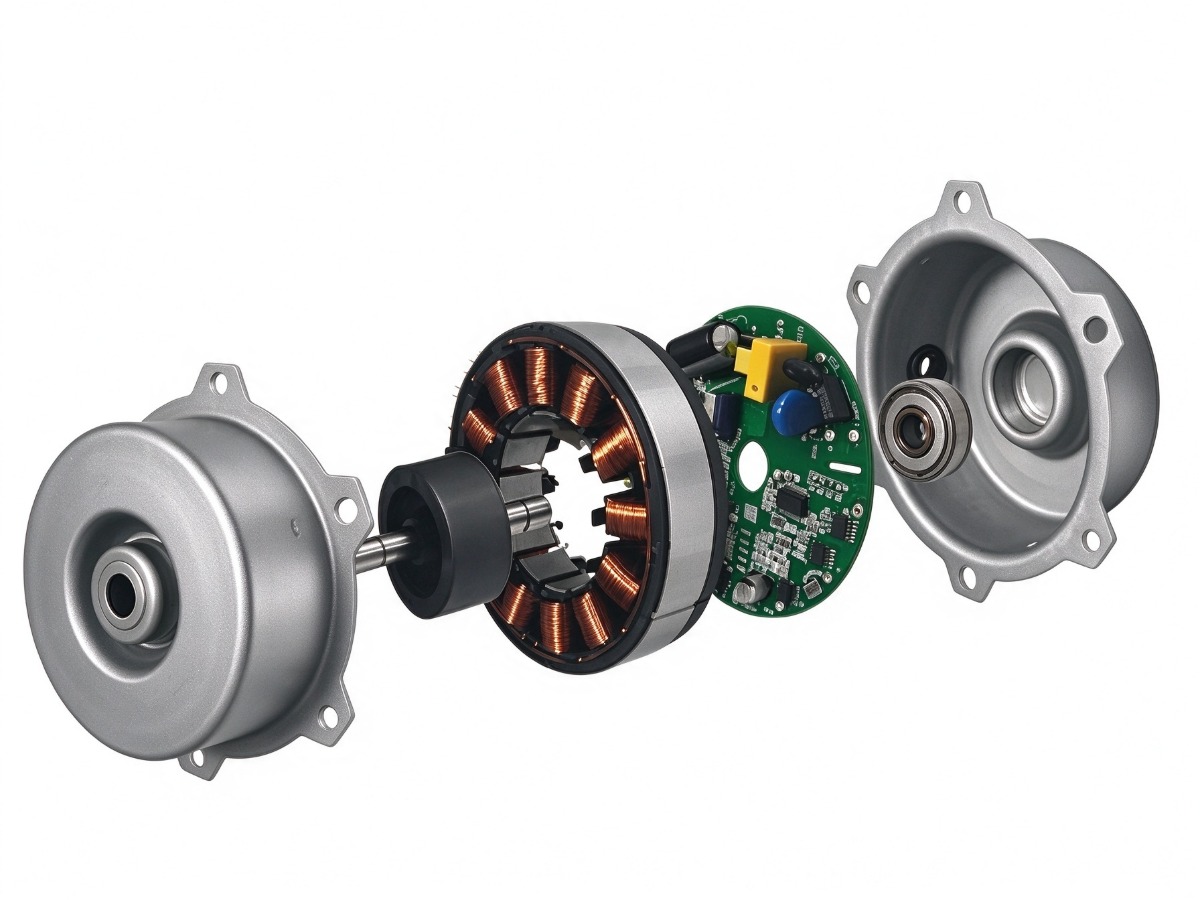
In a capacitor-run induction motor such as the RH7816, the stator winding produces a rotating field straight from the AC line. Torque comes from slip, a few percent, and slip is why speed falls under load. A BLDC motor such as the BLDC-RH7612 rectifies that input to a DC bus and switches it through six devices in step with rotor position: more electronics, no slip.
- Commutation: fixed by line frequency and slip, against electronic and position referenced.
- Speed: set by pole count and frequency, against set by the controller within its torque limit.
- Wear items: run capacitor and bearings, against bearings, bus capacitors and board temperature.
- Driver: none, against an onboard board or an external driver specified with the motor.
Efficiency and service life
The RH7816 is a 45 W four-pole capacitor-run motor at 1400–1500 rpm, rated at or below 40 dB(A). The BLDC-RH7612 delivers 24 W at 1500 rpm from a 200–240 V AC input with internal 24 V conversion, at or below 30 dB(A). At equal air movement the BLDC draws less line current and is not tied to a synchronous speed the impeller rarely wants.
Service life does not automatically favour BLDC. Bearings dominate both designs, and both offer class F insulation and IP54 protection. The BLDC adds a power board and bus capacitors inside the housing, and a board at 105 °C ages faster than one at 70 °C. A capacitor-run motor has one wear item: the run capacitor.
Speed control, noise and BOM impact
Three speeds from an induction motor means tapped windings or a triac dimmer that buzzes at low output. Three speeds from a BLDC means a PWM or 0–10 V input and a controller that holds the setpoint as the filter loads. The BLDC-RH8218 adds a 5 V analog input and closed-loop feedback on the board, so airflow stays near target as pressure rises.
| Criterion | BLDC fan motor | AC capacitor-run motor |
|---|---|---|
| Speed range | Wide; PWM or 0–10 V, held by feedback | Pole count and frequency; falls with load |
| Part-load efficiency | High; speed and torque decoupled | Falls as slip leaves the design point |
| Speed holding | Closed loop on the RH8218 class | None without external sensing |
| Noise | ≤30 dB(A), RH7612 class | ≤40 dB(A), RH7816 class |
| Life limiters | Bearings, bus capacitors, board heat | Bearings and the run capacitor |
| Driver and BOM | Board or driver; EMI layout work | One capacitor, no electronics |
| Control interface | PWM, 0–10 V, tachometer output | Relay, triac or tapped winding |
| Cost structure | Higher motor cost, fewer system parts | Lower motor cost, more AC parts |
| Best fit | Variable airflow, tight noise targets | Fixed speed, hot air, cost first |
Cost structure, and when AC still wins
BLDC unit cost is higher: magnets, a board and the engineering behind both. The honest comparison is at system level. If the platform already has a controller and a DC rail, BLDC needs no extra supply. If it does not, an AC-input integrated BLDC such as the RH7612 removes the external driver, and that is where the bill-of-materials saving usually appears.
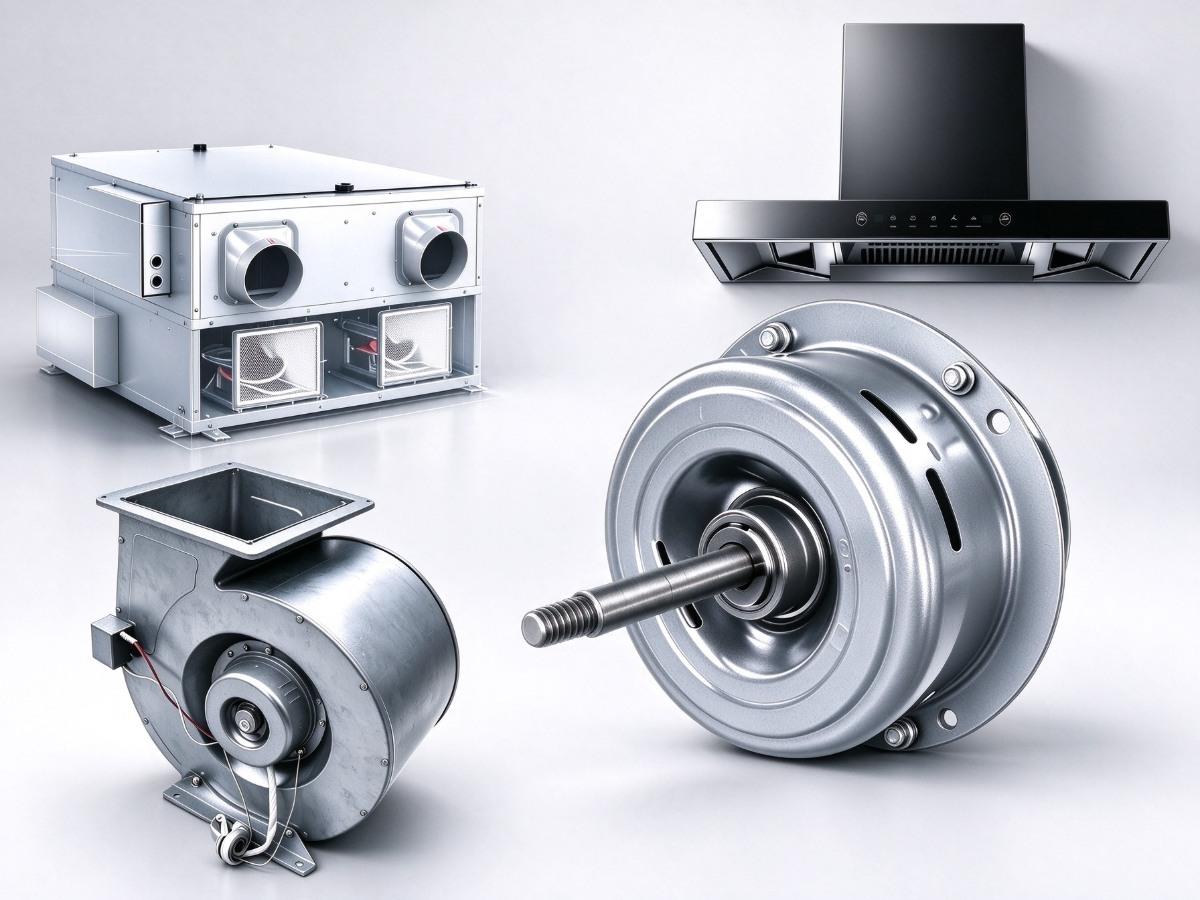
AC still wins in three cases. Fixed-speed equipment where airflow is set by a damper. Air paths above roughly 60 °C, where board life becomes the limit before bearing life. And multi-voltage platforms for 110 V and 230 V markets, where a four-pole induction motor with a capacitor is the cheapest robust answer. The fan motor range and application notes cover both families, or contact us with the duty point.
Selection checklist
- Fix the duty point at the worst filter condition: airflow and static pressure together.
- Convert it to shaft power at the impeller best efficiency point, then add margin.
- Choose the control interface first: relay, PWM, 0–10 V, or closed-loop airflow.
- Check the thermal path: ambient, duct air temperature, and board location.
- Confirm the supply: 110 or 230 V single-phase, an existing 24 V rail, or a 310 V bus.
- Ask for noise data in the actual mounting, not on an open bench.
- Cost the whole set: motor, driver, supply, harness and certification.
Pick the motor that matches the control the platform already needs; once airflow has to vary, the induction motor becomes the expensive choice.
Frequently asked questions
Can a BLDC motor replace an AC motor without changing the impeller?
Mechanically it usually can, if shaft diameter, flange and mounting pattern match; both the RH7612 and the RH7816 use an ø8 shaft. The speed-torque curve still differs, so re-check the impeller at the new operating point before releasing the swap.
Which one is quieter at the same airflow?
At equal airflow a BLDC normally runs at lower rpm with smoother commutation, which is why the RH7612 class is rated at or below 30 dB(A) against 40 dB(A) for the RH7816 class. Impeller and duct noise can still dominate, so measure the assembly.
Do I need an external driver for a BLDC fan motor?
Not always. The RH7612 and RH8218 carry the power and control board inside the housing, and the 310 V platform can be supplied with its driver as a set, as described in the 310 V DC motor guide. Integrated versions simplify wiring but fix the board thermal environment.
Need a motor matched to your appliance?
Send your voltage, speed, shaft and mounting requirements. Our engineering team replies with a proposal, drawing and sample plan.
Request a quote