How to Specify a Dehumidifier Fan Motor: Humidity, Duty Cycle and Noise
A dehumidifier runs for weeks in near-saturated air, and that is what fails its fan motor. What to specify for the evaporator and condenser air path, from insulation to noise.
On this page
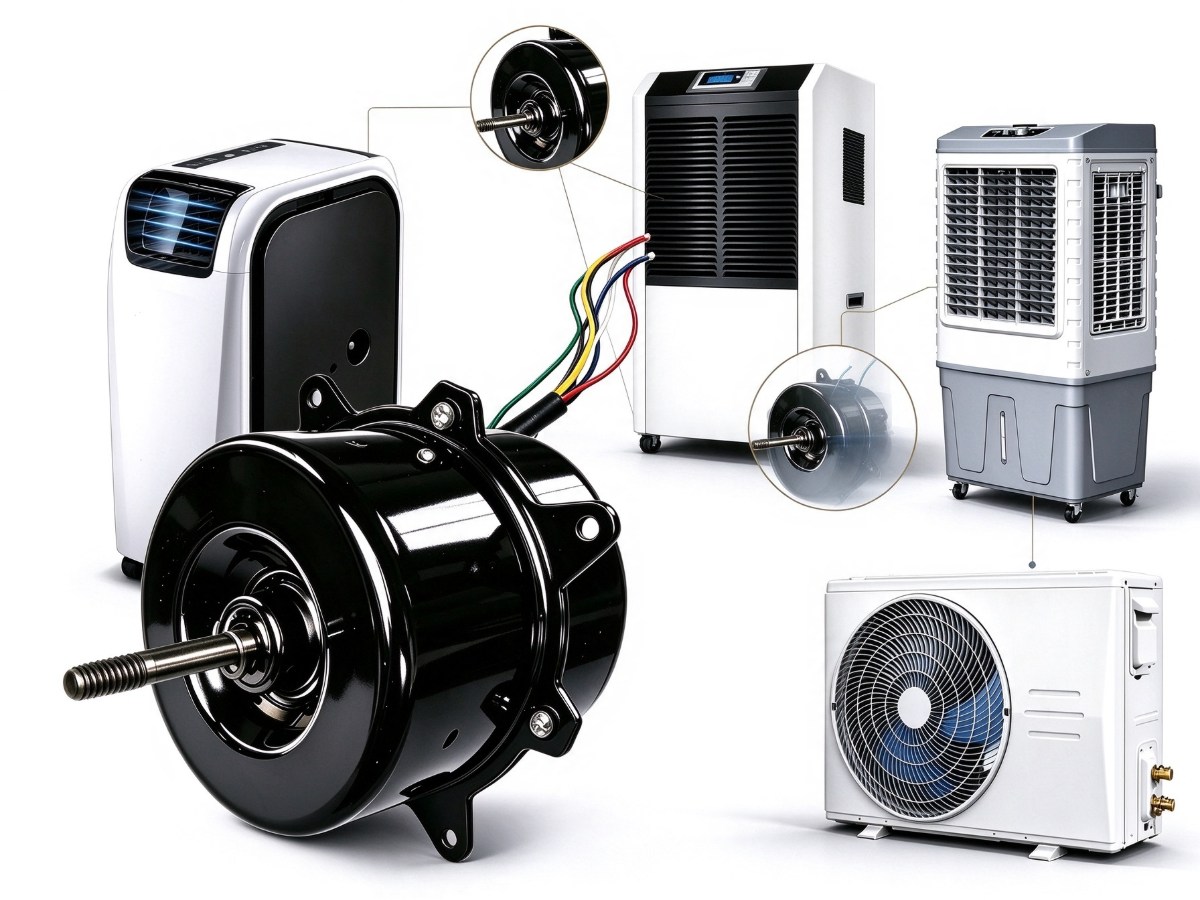
A dehumidifier fan motor runs for weeks at a time, in air close to saturation, on a shaft that passes through a wet compartment. That combination, not the airflow figure, is what fails motors in this product category. This guide sets out the conditions a dehumidifier imposes, the two motor families that fit them, and the specification inputs a supplier needs before quoting.
What the air path does to the motor
A refrigerant dehumidifier pulls room air across the evaporator, where it is cooled below dew point and water leaves the airstream, then across the condenser, where the same air is reheated before it returns to the room. The fan sits in that loop, usually downstream of the condenser, so it handles air at roughly 30–45 °C and high relative humidity, in a chassis that is compact and warm.
- Continuous duty: operation measured in days, so bearing and capacitor life set the service interval.
- Condensed moisture: droplets and mist travel with the air and reach the motor face.
- Warm air path: motor ambient 10–20 °C above room temperature inside a compact chassis.
- Low noise expectation: the compressor is already the loudest part, so the fan must not add a tone.
Warm, wet air: insulation, ingress and bearings
Class F insulation is the baseline, and IP54 is the practical minimum for a motor in this air path; both are standard on the RH8226 and RH9437 induction motors and on the BLDC-RH7612. Aluminium-wire stators are common here because they tolerate high winding temperature at lower cost than copper, and a thermal protector in the winding cuts the motor if condenser airflow is blocked.
Bearings are where continuous duty shows up first. Sealed or shielded rolling bearings keep condensed moisture off the raceways, and an inverted mounting needs an arrangement that will not let water pool against the seal. If the motor sits shaft-up under a drip path, a slinger or a small drain in the bracket is cheaper than a higher IP rating.
24 V BLDC or AC capacitor-run
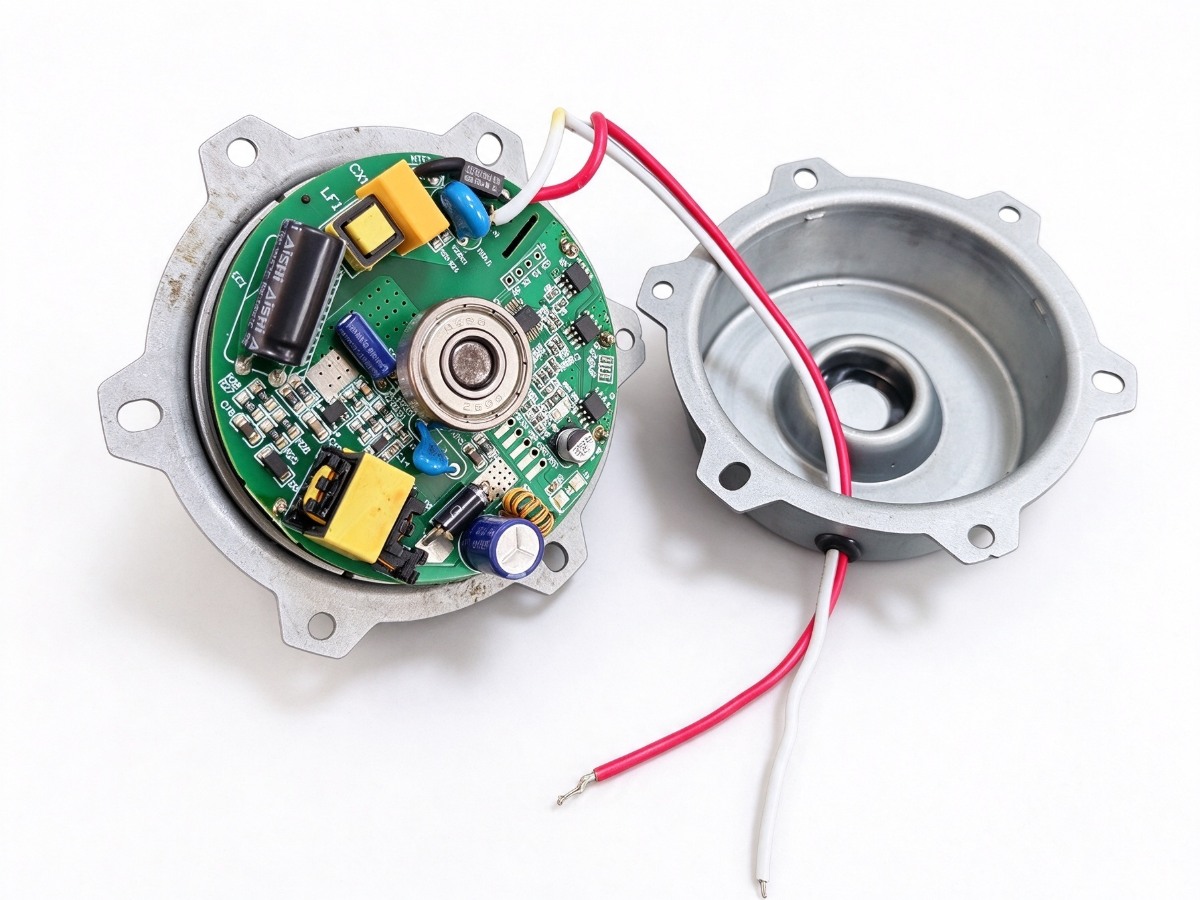
Both families work; the choice follows the control the appliance already has. A capacitor-run motor needs a triac or relay and a run capacitor, and gives one or two speeds. A 24 V BLDC fan motor takes a PWM input, and a closed-loop variant holds speed as the coil load and the filter change.
| Specification input | Why it decides the motor | Typical answer |
|---|---|---|
| Airflow and static pressure | Sets impeller and shaft power | Duty point at the wettest coil, not dry |
| Supply inside the chassis | Decides BLDC or AC | 24 V DC rail, or single-phase 230 V |
| Motor ambient | Sets insulation class and board temperature | Class F, 40–50 °C local ambient |
| Mounting and drip path | Decides IP rating and bearing protection | IP54, sealed bearings, drain-aware bracket |
| Duty and expected life | Sets bearing and capacitor specification | Continuous duty, life target in hours |
| Noise at one metre | Prevents a tonal complaint after tooling | State the figure with the mounting |
The BLDC-R-MD8E is the other shape of the same answer: a 6 W integrated motor with a 200–240 V AC input, an internal 12 V conversion, both boards inside the housing and noise at or below 30 dB(A), built for exhaust and air-exchange duty. Where the chassis has no DC rail and no room for a driver, an AC-input integrated BLDC removes both problems at once.
Noise, duty cycle and what to write into the specification
State the noise target as sound pressure at a defined distance, with the motor mounted in the appliance, and add a limit on tonal content if the unit runs in a bedroom. A motor rated at 30 dB(A) on a bench can read 38 dB(A) once the impeller and the panels resonate, so the number that matters is measured in the assembly.
Write the duty cycle as continuous with the expected number of start-stop cycles per day, because starting current is what stresses the capacitor and the winding. For a BLDC, the equivalent inputs are the number of speed changes and the ambient at the board. Both families take custom shaft, lead wire and mounting, which is usually cheaper than redesigning the chassis; the motor range shows the options, and contact covers sample evaluation.
In a dehumidifier the motor is selected by the air path and the duty cycle; airflow is only the starting number.
Frequently asked questions
Can I use a standard exhaust fan motor in a dehumidifier?
Only if its ingress protection, insulation class and bearing sealing suit a warm, wet air path. A motor rated for intermittent duty in dry air often fails at the bearing or the winding within months of continuous running. The air purifier motor guide covers the drier version of the same duty.
Is BLDC quieter than an AC motor here?
Usually at equal airflow, because it runs at lower rpm and commutes smoothly; the RH7612 class is rated at or below 30 dB(A) against 40 dB(A) for the RH8226 and RH9437 class. The compressor and impeller still dominate, so treat the motor as one contributor.
What protects the motor if the filter blocks?
A thermal protector in the winding, or a driver with current and locked-rotor protection. Blocked airflow raises winding temperature before it raises current much, so temperature sensing is the more direct protection, and the RH9437 carries an integrated thermal protector for that reason.
Need a motor matched to your appliance?
Send your voltage, speed, shaft and mounting requirements. Our engineering team replies with a proposal, drawing and sample plan.
Request a quote